Healthy ageing6 min read
What Your Body Composition Actually Tells You (That the Scale Can't)
The scale tells you how heavy you are. Muscle, fat distribution and bone density reveal a much more useful picture of your health after 40.
Better Years · By Advanced Integrative Wellness

Most of us have one number we use to judge our own health. We step on the bathroom scale in the morning, read the number, and decide whether we're doing well or badly based entirely on how it's changed since last time. Up is bad. Down is good. That single number carries enormous weight—in every sense.
It's a convenient habit. The scale is cheap, it's already in the bathroom, and it gives you an answer in two seconds. But it's also one of the least useful numbers you can track, especially once you're past 40. It answers a question that barely matters while staying completely silent on the ones that do.
Here's the core problem with weight: it tells you how heavy you are, and almost nothing about what you're made of. In midlife, what you're made of decides how the next thirty years go.
The same number, two very different bodies
Picture two people of the same height standing on the same scale, reading exactly the same weight. On paper, they're identical. A doctor glancing only at that figure would treat them the same.
Now look underneath the number.
The first person carries a healthy amount of muscle, a modest, well-distributed amount of fat, and strong, dense bones. They're built to stay steady, mobile and independent for decades. The second person, at the same weight, has noticeably less muscle, more fat stored in the exact places that cause long-term trouble, and bones that have quietly thinned without a single symptom to announce it.
Same figure on the scale. Completely different outlook for the years ahead.
This is why the scale can mislead you in both directions at once, and why so many people in midlife are quietly misreading their own health. You can lose weight and feel genuinely pleased with yourself, while a good portion of what you lost was muscle—a change you would never have chosen if you'd known. Or you can hold a perfectly steady weight for years, congratulating yourself on your consistency, while your body composition shifts underneath you the whole time — muscle slowly traded for fat, gram for gram — without the number on the scale ever moving enough to warn you.
The scale isn't lying to you. It's just answering a much smaller question than the one you're really asking.
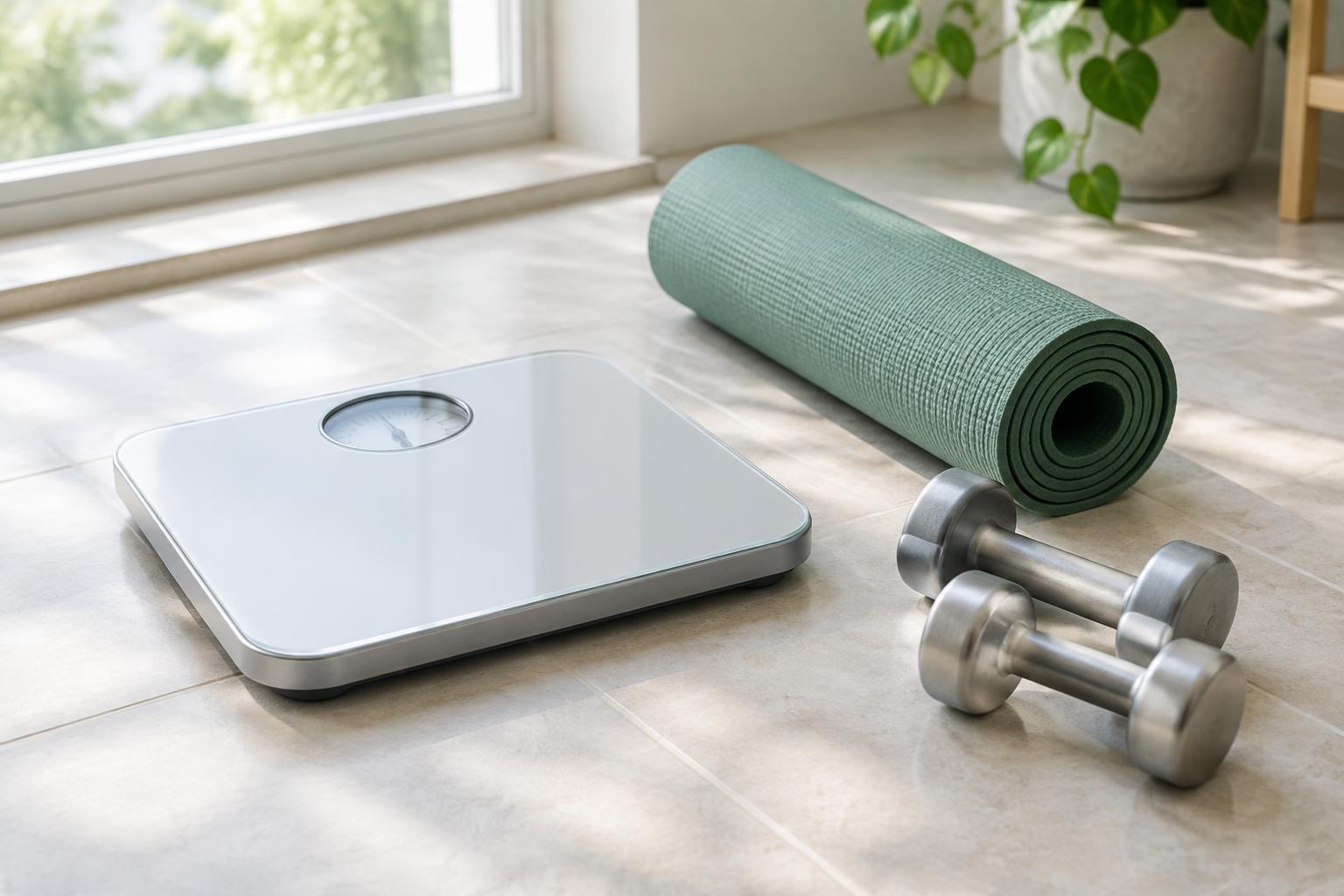
The three things worth knowing instead
A body composition scan—the most detailed and widely used of which is a DEXA scan—looks past total weight to what actually shapes how you age. Three are worth understanding.
Muscle. From around age 40, the body gradually loses muscle mass if nothing is done to maintain it—a process that quietly accelerates with each passing decade. This matters more than most people realise, because muscle does far more than let you lift things. It keeps you steady on your feet and lowers your risk of falls that so often mark the end of independent living. It's closely tied to how your body handles energy and blood sugar. It also affects how well you recover from illness or surgery later in life. The encouraging part, and it's worth repeating, is that muscle is one of the few things you can genuinely rebuild at almost any age — but you have to know how much you're working with before you can do anything sensible about it.
Fat — and specifically, where it sits. Not all fat behaves the same way, and the scale— and even the mirror— fail completely. The fat you can see and pinch, sitting just under the skin, is relatively harmless. The fat that quietly gathers deep inside the abdomen, wrapped around your organs — called visceral fat — is an entirely different matter. It's the type most closely linked to the serious long-term health concerns midlife worries most about. And here's the catch: you can't see it from the outside. A slim person who looks perfectly healthy in the mirror can carry a surprising amount of it, with no outward sign. A proper scan is one of the only straightforward ways to actually know what's there.
Bone density. Bones lose density slowly and silently with age, and unlike muscle, they give almost no feedback. There's usually no ache, no stiffness, no signal of any kind — until the day something breaks that shouldn't have. Knowing where your bone density sits, well before a problem arises, is one of the most useful pieces of information you can have about your long-term health. It's far easier to protect bone you still have than to try to rebuild bone you've already lost, and that advantage only exists if you look early.
Why this matters more the earlier you look
There's a reason to do this sooner rather than later, and importantly — it isn't fear.
Almost everything described above responds far better to early attention than to late reaction. Muscle is much easier to maintain than to rebuild from a depleted base. Bone is easier to protect than to recover. Visceral fat is easier to address early than after years of quiet, unmeasured accumulation. In every case, the person who knows sooner has more, better options than the person who finds out later.
Health works a little like compound interest. Small things, left alone and unmonitored, add up steadily over time—and in both directions. The person who checks their numbers at 45 and makes a few modest, informed adjustments works with time on their side. The person who waits until something forces the issue at 60 is trying to make up ground against it. The actions might even be similar; the difference is how much room each of them has to work in.
And it's worth saying clearly, because the whole subject can sound heavy: very often, the scan simply brings good news. It confirms you're on track, that the things you've been doing are working, and that you can carry on with a genuinely clearer mind rather than a vague, nagging hope that you're probably fine. That peace of mind is a real and underrated result in its own right. Knowing is better than wondering, no matter how the numbers fall.
Where to start
You don't need to overhaul your entire life to begin, and you certainly don't need to buy the latest supplement or sign up to the strictest plan. You need one honest, accurate picture of where you're actually starting from.
A body composition scan gives you exactly that—a clear read on your muscle, where your fat is distributed, and your bone density—instead of a single bathroom figure that quietly tells you none of it. From there, anything you decide to do—whether that's adjusting how you eat, adding resistance training, or simply keeping a closer eye on one specific number over time—is grounded in what's genuinely true for your body, not a guess dressed up as a plan.
The scale answers one small question: how heavy am I? The far more useful question — how well am I actually built for the years ahead? — has always needed a better instrument. The good news is that the better instrument exists, it's accessible, and the only real decision left is whether you're willing to look.